“The Dishonest Decade”

The Spanish Civil War (1936-39) took place against a background of deceit caused primarily by the democracies’ fear and inability to act against the Fascist regimes of Germany and Italy. When the Nazi invasion of Poland in September 1939 finally put an end to the illusion of peace, the poet WH Auden penned these lines from New York:
“On Fifty-second Street
Uncertain and afraid
As the clever hopes expire
Of a low dishonest decade”
Spain, along with Czecholsolvakia, had been one of the democracies sacrificed in the interests of maintaining the illusion of peace during that”dishonest decade”. Contrary to popular belief, the country was not poor but had suffered from centuries of misrule and exploitation by a fossilized alliance of church, army and aristocracy. The Goya etching below of two naïve peasants willingly supporting the burdens of asinine politics summed up the lot of a great many Spaniards well into the 20th century. In April 1931, after the popular vote went gainst him, King Alfonso XIII fled into exile, never to return.

Enemies from Within and Without
A Republic was declared, and the new regime’s objective was to bring about a long-desired transition to a modern democracy but the Great Depression and the hostility of world markets severely impacted its hopes. Enemies on both the Left and the Right began to assert themselves aggressively in much the same way as they were doing in France. An attempted coup in 1932 failed when the ringleader’s overloaded plane crashed on takeoff. In 1934, the government savagely put down a miners’ rebellion in the province of Asturias, using army units under the command of one of the youngest generals in Spain, General Francisco Franco. In Barcelona and Madrid, anarchist unions made demands the government could never hope to fulfil. By the summer of 1936 it was no longer a question of whether there would be another coup attempt, but when. The words of Irish poet WB Yeats, written in 1921, prophetically reflected what was about to happen:
“Things fall apart; the centre cannot hold; Mere anarchy is loosed upon the world, The blood-dimmed tide is loosed, and everywhere The ceremony of innocence is drowned.”
The War Begins
That fateful day came on July 18th, 1936. Having secured commitments from Germany and Italy, the insurgents, or “nationalists” as they called themselves, were determined to terrorise their way to victory. Summary executions of Republicans in the streets of Seville were quickly followed by the slaughter of over 2,000 prisoners in the bullring at Badajoz, an atrocity that gripped the attention of the world. An eye-witness to the carnage, Condor Legion officer Hans Von Frunk, one of the few high ranking Germans advisors present, warned against the deployment of German troops in the conflict. He declared he was “a soldier used to combat, who had fought during the World War but had never seen such brutality and ferocity as that with which the African Expeditionary Force carried out its operations. Faced with such savagery,” he concluded, “German troops will become demoralised.” Unfortunately the course of the war was to prove exactly the opposite.

German mercenaries: Condor Legion passing-out parade, Hamburg 1939
The man responsible for the Badajoz massacre replied when interviewed by reporter Robert Whitaker, “Of course we shot them. What do you expect? Was I supposed to take 4,000 reds with me as my column advanced, racing against time? Was I expected to turn them loose in my rear and let them make Badajoz red again?”
Postwar Collusion and Repression
In the end almost 300,000 people lost their lives, more than 120,000 of them civilians, and more in reprisals that continued up to 1944. Those who hoped the Allied victory in Europe would lead to regime change in Spain were to be cruelly disappointed: in May 1944, Winston Churchill, addressing Parliament just before the D-Day landings, virtually endorsed what had become known as “The White Terror” in Spain by declaring that Spain’s internal problems were a matter for the Spanish people themselves. The last Republican fugitive, an anarchist, was executed by firing squad in Madrid in April 1963.

Civil Guards in Extremadura, 1951. From the cover of Death of A Nationalist by Rebecca Pawel
It should therefore come as no surprise that tensions have remained acute between Spaniards to this day: the Civil War is not a subject many wish to revisit.
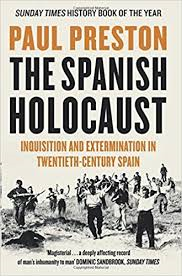
Professor Paul Preston of the London School of Economics chronicles the extent of postwar reprisals in Franco’s Spain
The International Brigades
The open intervention of fascist Germany and Italy led directly to the creation of the International Brigades on the Republican side. Almost 40,000 volunteers came to Spain, largely recruited through the offices of the Communist International in Paris. Many who fought with the Brigades later claimed after service in WWII that fighting in Spain meant more to them than liberating Europe from the Nazis. This man was one of many.

Major Milton Wolff and International Brigade Officers on the Ebro, 1938 / Courtesy Despues del Hipotamo.com
Franco’s allies were the powerful and clerical
Few on Franco’s side ever repented their actions, either then or since. Pride and passion run high in Spain in spite of the cruelty caused by the war, and this is evident in voting patterns even today. For the 700 Irish volunteers who came to Spain to fight for Franco – far more than from any other nation – the war was a crusade against Communism, the bête noire of the Catholic church.

Franco’s Irish: General O’Duffy is seated front, fifth from right
The War In Madrid
The rebels began by taking over key installations throughout Spain, and confidently expected to secure control of the country in a matter of days. Indeed, in cities such as Seville and Burgos, they were immediately successful. But not where it mattered, and what happened afterwards gave rise to a conflict that would last the best part of three years. In Barcelona, the rebels were driven out of the telephone exchange and radio stations by a popular uprising; in Madrid, armed civilians led by NCOs, police and lower ranks loyal to the Republic converged on the Montaña army barracks where a massacre took place following a fake surrender attempt by the occupants. The world’s press seized on the gruesome pictures of the massacre.

Insurgents surrendering to armed militia at the Montaña barracks in Madrid, July 1936
The city of Madrid was to hold out for another 1000 days, and surrendered only when the Republic laid down its arms in March 1939, barely six months short of the outbreak of the Second World War. Madrid was never captured. This tour incorporates the story of Madrid’s proud and heroic resistance and the sacrifices made by a dispossessed people living under siege for almost three years. It is the story of Franco’s attempts to invest the city, and when he couldn’t, of his failed attempts to starve and bomb it into submission.

Sheltering from aerial bombardment in the Madrid Metro, November 1936
Foreigners In Madrid
It is the story of the International Brigades, who came from every corner of the world to defend the Spanish Republic, and the medical services under Dr. Norman Bethune and Dr Frederic Durán Jordá who developed revolutionary practices in blood transfusion and the treatment of wounds.

Dr. Norman Bethune of Canada (centre ) and his mobile transfusion crew
It is the story of writers and journalists who believed Madrid was the only place to be, in spite of the bombs.

Ernest Hemingway and Martha Gellhorn at the Stork Club, New York, 1938
And the last word goes to….
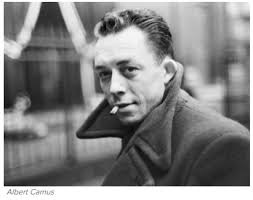
Perhaps the most fitting comment on the Spanish Civil War was that made by French writer and philosopher, Albert Camus:
“It was in Spain that my generation learned that one can be right and yet be beaten, that force can vanquish spirit, that there are times when courage is not its own recompense. It is this, doubtless, which explains why so many, the world over, feel the Spanish drama as a personal tragedy”